Not too long ago, the Chief Financial Officer was viewed as the organisation's financial custodian; the executive responsible for budgets, compliance, capital allocation and financial stewardship. Today, that definition is rapidly becoming obsolete.
As enterprises accelerate their investments in AI, digital banking, blockchain, intelligent automation and platform-based business models, finance leaders are increasingly expected to shape enterprise strategy rather than simply report on it. The CFO has evolved into one of the most influential voices in the boardroom, balancing fiscal discipline with digital transformation, innovation and long-term value creation.
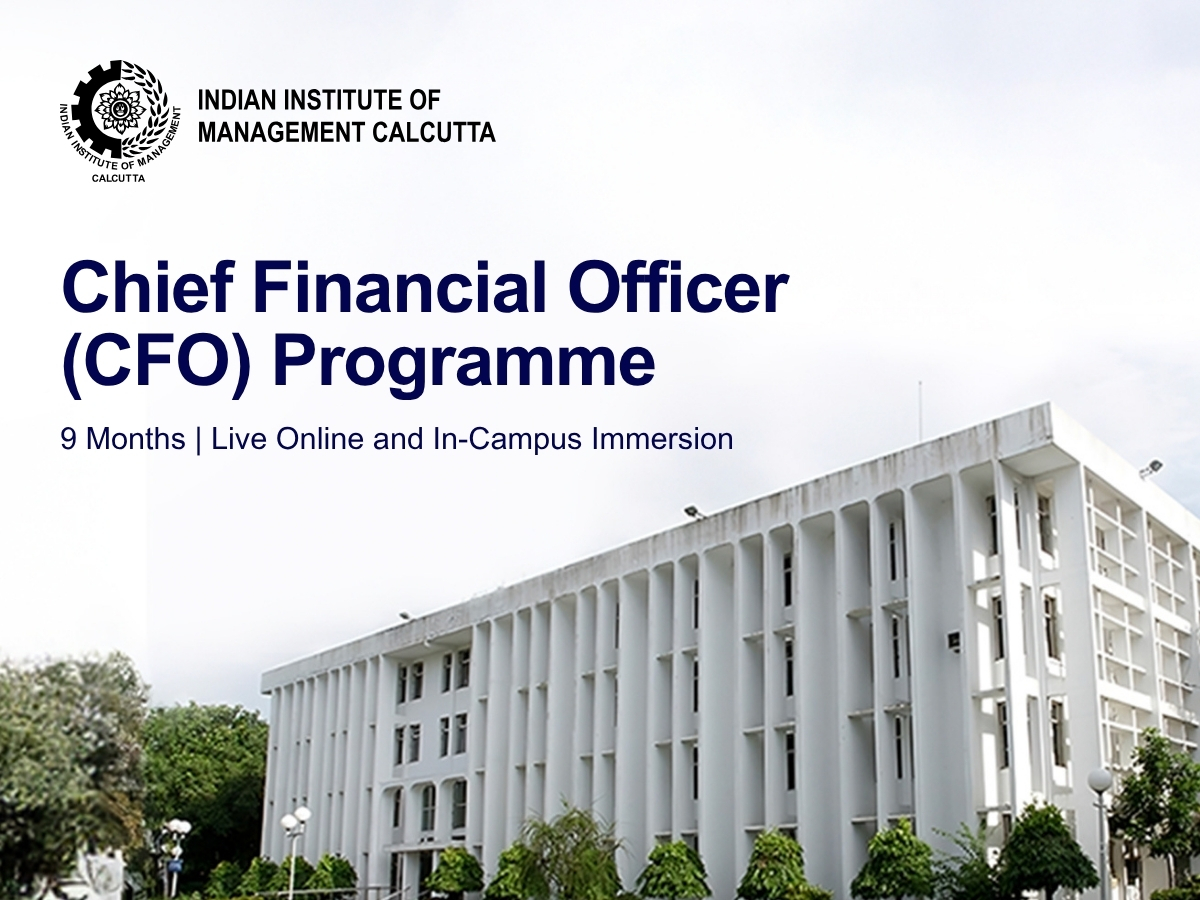
It is this changing mandate that has prompted Indian Institute of Management Calcutta (IIM Calcutta) to launch the 8th batch of its Chief Financial Officer (CFO) Programme—a reflection of both the programme's growing legacy and the continued demand for finance leaders who can navigate an increasingly technology-led business landscape.
A programme that has evolved with the CFO role
As the responsibilities of finance leaders expand, executive education must evolve alongside them.
The latest edition of IIM Calcutta's CFO Programme introduces an enhanced curriculum designed around the realities of modern financial leadership. While the programme continues to strengthen participants' expertise across corporate finance, governance, competitive strategy and business leadership, it also places greater emphasis on the technologies redefining the finance function.
Participants are introduced to themes such as digital transformation, Industry 4.0, Generative AI, design thinking and technology-enabled business models—subjects that increasingly influence how finance leaders evaluate investments, manage enterprise risk and enable organisational growth.
The evolving curriculum also reflects the wider transformation taking place across financial services. As digital banking ecosystems mature, blockchain applications move beyond experimentation, and AI reshapes forecasting, compliance and decision-making, finance leaders require capabilities that extend well beyond traditional accounting and treasury functions.
Rather than treating technology as a specialist domain, the programme positions it as a strategic leadership capability.
Learning from one of India's most respected institutions
The programme's sustained success over eight cohorts is closely tied to the academic standing of IIM Calcutta itself.
Established in 1961, IIM Calcutta remains one of India's foremost management institutions and is recognised globally for its academic rigour and leadership in management education. It is India's first business school to earn the coveted Triple Crown accreditation—AACSB, AMBA and EQUIS—placing it among a select group of business schools worldwide recognised for excellence across teaching, curriculum and institutional quality.
The programme also grants participants Executive Education Alumni Status, connecting them to a growing network of more than 300 finance leaders from previous cohorts. Combined with live faculty-led learning and campus immersions, the experience extends well beyond classroom instruction into peer learning and executive networking.
Preparing finance leaders for what's next
Industry research increasingly suggests that tomorrow's finance leaders will spend as much time shaping business transformation as they do manage financial performance.
Recognising this shift, the programme's curriculum integrates modules spanning organisational leadership, corporate governance, digital transformation, business strategy, deep finance and design thinking. Through case discussions, simulations and a capstone project, participants are encouraged to apply these frameworks to complex business challenges, strengthening their ability to lead across functions rather than within finance alone.
As organisations continue to navigate AI adoption, evolving regulatory environments and technology-driven disruption, the expectations from CFOs will only continue to expand.
The launch of the eighth cohort is therefore more than another edition of a successful executive programme. It reflects the continuing evolution of one of the C-suite's most critical leadership roles, and the growing need for finance leaders who are equally fluent in business strategy, emerging technologies and enterprise transformation.
Click here to know more about the programme.