For decades, classroom assessment has followed a familiar pattern. A teacher completes a chapter, students prepare for an examination, answer sheets are evaluated days or weeks later, and only then does the teacher discover who understood the concept and who didn't. By that time, the class has already moved on.
For the students who failed to grasp the concept, the opportunity for timely intervention has often passed. This is perhaps one of the biggest yet least discussed challenges in education today.
The purpose of assessment was never meant to be awarding marks. Its real purpose is to provide teachers with continuous feedback on every child's learning journey.
Unfortunately, in many classrooms, assessments have become an event instead of an ongoing process. Artificial Intelligence is now making it possible to change that.
The Shift from "Testing Learning" to "Improving Learning"
One of the most significant shifts happening in education today is the move away from examination-driven learning towards continuous formative assessment.
Instead of asking, "How many marks did this child score?", teachers are beginning to ask a far more meaningful question:
"Did every child understand today's concept?"
That single shift changes everything.
When teachers receive feedback immediately after teaching a concept, they can revisit misconceptions, provide additional support, and ensure no child is left behind before progressing to the next lesson.
Educational research has consistently shown that timely feedback has a far greater impact on learning outcomes than delayed evaluation. Yet, implementing continuous assessment has traditionally been difficult because it requires significant teacher time and administrative effort.
This is where AI is beginning to transform classrooms.
Making Real-Time Assessment Practical for Every Classroom
While digital quizzes and learning management systems have existed for years, they often depend on every student having access to a mobile phone, tablet or laptop—something that remains impractical in many schools, particularly in developing countries.
More importantly, introducing devices into classrooms can create distractions and widen the digital divide.
A new approach is emerging that combines the simplicity of paper with the intelligence of AI.
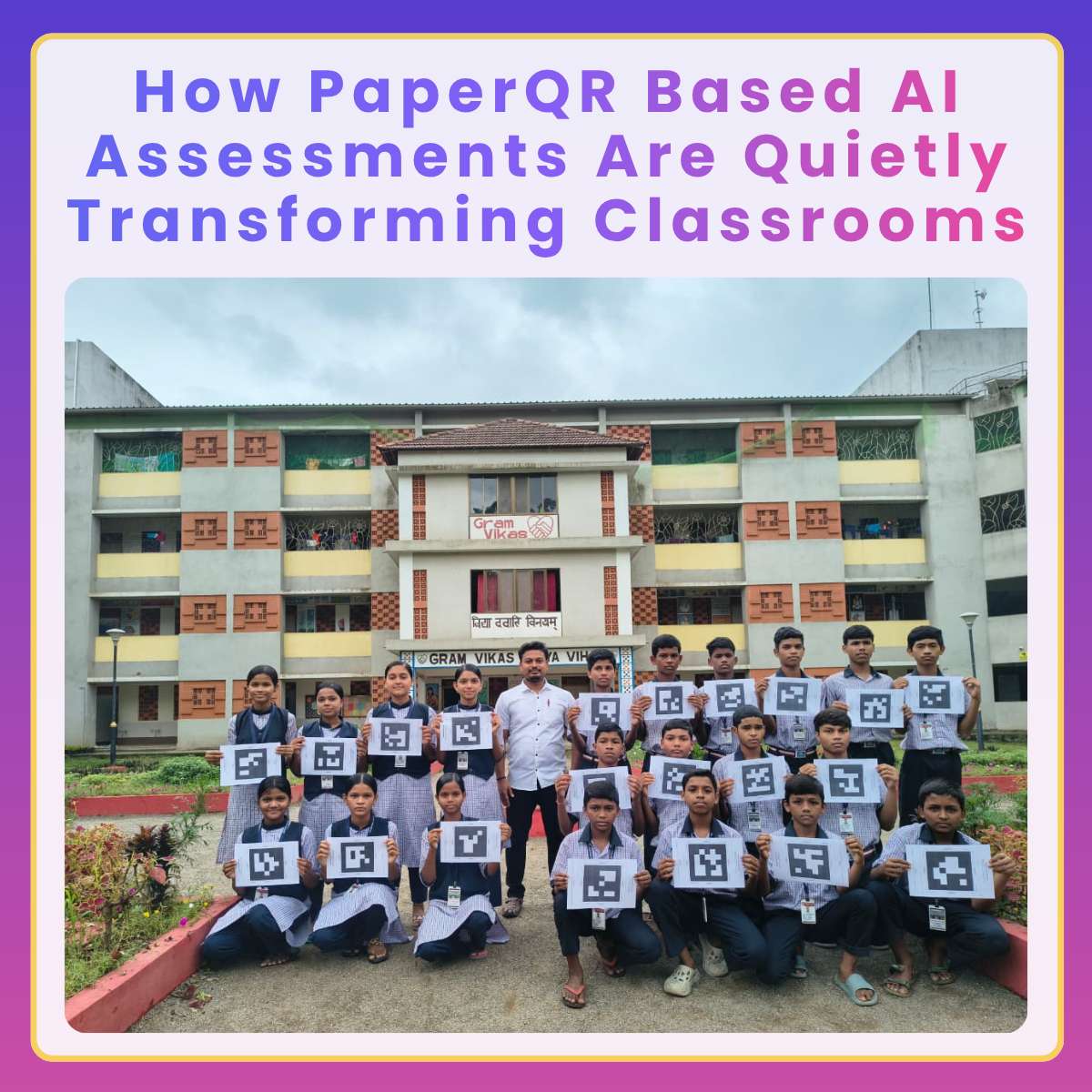
Using TeachBetter.ai’s innovative PaperQR Live Quiz, every student receives a unique printed QR response card. Each side of the QR denotes an option - a, b, c or d. During the lesson, the teacher poses questions generated using AI, and students simply hold up their PaperQR cards with the correct option at the top side, to indicate their answers.
The teacher then scans the classroom using a standard smartphone.
Within seconds, AI processes every response simultaneously and generates instant insights on participation, correctness and learning gaps—without requiring students to use any electronic device.
The assessment becomes almost invisible. Instead of interrupting learning, it becomes part of the teaching process itself.
Why This Matters Beyond Technology
The true innovation is not the QR code or the computer vision technology. It is what becomes possible because of it.
Teachers can now check understanding after explaining every important concept instead of waiting for a monthly test.
Students remain attentive because they know every lesson is interactive.
Participation increases dramatically because every child responds—not just the few who raise their hands.
Most importantly, teachers receive immediate evidence of whether learning has actually happened.
If half the class misunderstands a concept, the teacher knows instantly and can reteach it before moving ahead.
Assessment stops being a judgement of learning and becomes a tool for improving learning.
That is a profound shift in classroom practice.
Creating Equal Opportunities Across Urban and Rural Schools
One of the most encouraging aspects of PaperQR based AI assessments is their accessibility.
Schools do not need expensive smartboards, computer labs or one device per student or physical clickers.
A teacher needs only a smartphone and printed PaperQR response cards.
This makes the approach equally relevant in metropolitan private schools and resource-constrained rural classrooms.
Several schools have already begun demonstrating what this future could look like.
Schools in different parts of India are using AI-powered classroom tools to make lessons more engaging and assessments more continuous. At the same time, educators in Kenya have successfully adopted PaperQR Live Quiz to conduct real-time classroom assessments without requiring student devices, demonstrating that this approach is practical across diverse educational settings.
Organisations such as Gram Vikas have also begun enabling teachers across their rural residential schools in Odisha with AI-powered teaching tools like TeachBetter.ai, highlighting how meaningful educational innovation can reach classrooms serving first-generation learners just as effectively as those in urban centres.
When technology is designed around teachers rather than infrastructure, it becomes far more inclusive.
The Future Classroom Will Be Feedback-Driven
The classrooms of the future are unlikely to be defined by more examinations.
They will be defined by better feedback.
Artificial Intelligence gives educators something they have never truly had before: the ability to understand every learner's progress in real time without creating additional workload.
When every lesson ends with meaningful feedback instead of unanswered questions, teachers can personalise instruction, intervene earlier and help every child build deeper conceptual understanding.
Education has always been about helping children learn.
Perhaps it is time that our assessments did the same.