
Teja Reddy made every mistake a first-time founder makes. Wrong supplier. Too many products. Weeks of silence. Two years later — entirely bootstrapped, not a rupee of outside money — she has a brand parents trust and a very clear idea of what she’d do differently.
Newborns sleep between 14 and 17 hours a day. Older infants sleep at least 12 to 15. Add the waking hours spent in onesies, bodysuits, and everyday essentials, and a child under six spends the overwhelming majority of their early years in basic essential wear — not in the party outfits that fill Instagram grids, but in the soft, everyday pieces pressing against their skin through naps, feeds, floor time, and sleep.
In India, where heat and humidity are permanent conditions for much of the year, that isn’t just a clothing consideration. It is a 24-hour cloth environment for a developing baby’s skin. And for most of that time, Indian parents had very few genuinely good options.
Teja Reddy knew this not as market research, but as a lived experience. And it took her almost everything she had — and not a single rupee of outside investment — to do something about it.
The Suitcase Years
Teja spent over a decade in the American technology industry — a computer science degree from Bengaluru, a Master’s in Information Systems and Management in the US, years building a stable career in tech. After becoming a mother, every trip home to India came with the same addition to her luggage: soft cotton onesies, breathable vests, basic essentials for her children that she couldn’t find in Indian stores at the quality she needed. She wasn’t hunting for anything exotic. She just wanted comfortable, well-made basics — the kind of thing that should be easy to find anywhere.
“It sounds like a small thing,” she says. “But when your baby is spending most of their day and night in a garment, the quality of that fabric is not a small thing. It’s the cloth environment they’re living in.”
When she moved back to Bengaluru permanently in 2023, she found the gap waiting exactly where she’d left it. India’s children’s clothing market was vast, colourful, and deeply indifferent to what was happening at the skin level. Conventional fabrics treated with chemical finishes, combined with synthetic fibres like polyester, trap heat and moisture against the skin — a real concern for babies whose skin is roughly 30% thinner than an adult’s and far more absorbent of whatever it contacts.
Teja decided to build something different. She had no background in fashion or manufacturing, no investors, no co-founder, and no guarantee it would work. What she had was a clear problem, a specific standard in her head, and the stubbornness to see it through.
The Year Nothing Went Right
Finding the right manufacturing partner took months. Sourcing 100% organic cotton and high-grade natural fabrics — chosen for breathability, anti-static properties, and pH-neutrality — took even longer. And in the meantime, she made the first of two mistakes she now talks about openly.
“I trusted the wrong supplier early on,” she says. “I was eager to move fast and didn’t verify carefully enough. The quality didn’t meet the standard I’d set. I had to pull back and start over. That cost real time and real money.”
The second mistake came at launch. “I tried to offer too many products at once. I thought variety would signal credibility. What it actually did was spread everything too thin.” She scaled back, narrowed the range, and did what more founders should do — went to the market first.
Testing The Market Before The Market Was Ready
Before committing to a full launch, Teja ran a soft launch — online and across physical markets in the city — putting early versions of Urbanrac’s essentials in front of real parents and listening carefully to what they said and what they didn’t.
“We barely got orders,” she says. “There would be days where almost nothing sold. That is a particular kind of quiet that makes you wonder if you’ve completely misread the situation.”
But the approach gave her something more valuable than early revenue: direct insight into what parents actually compared her against, what made them hesitate, and what they reached for first. That feedback went straight back into the product. And it has never stopped. Teja still talks to her customers personally — reading every message, asking follow-up questions, and using what she hears to refine fabric choices, tweak fits, and improve finishing. When a mother says the neckline is stiff, it gets fixed. When a father says the fabric pilled after a few washes, she goes back to the supplier. This direct line to the people actually using her products is, she believes, the clearest advantage a small bootstrapped brand has over a larger one. When Urbanrac launched properly in 2024, it was a leaner, sharper range built on ground truth — and that conversation with customers has never stopped shaping it.
Bootstrapped, And Doing It Anyway
Urbanrac has no venture funding. No angel round. No institutional backing of any kind. Every decision, every product iteration, every rupee spent has come from Teja herself — a bootstrapped brand built on conviction rather than capital. The logistics, the content, the customer communication, the design iteration: it all falls on her, directly.
“There are days when I’m designing or writing content at 4:30 in the morning,” she says. “And I wonder if I’m getting the balance right — between building the brand and being present for the children who are the whole reason this brand exists. I don’t have a clean answer for that. I just keep going.”
What bootstrapping forces is discipline. Without a marketing budget to paper over gaps, the brand lives or dies on product quality and word-of-mouth. Industry data shows 70% of parents prioritise comfort over style when choosing infant wear, and 45% will pay extra for hypoallergenic fabrics. Urbanrac is built for exactly that parent — the one who reads the label.
What The Brand Is Actually Made Of
Every Urbanrac garment is locally sourced, designed in Bengaluru, and manufactured in a facility run by women, with a design process led by women. The fabrics — 100% organic cotton and high-grade natural fibres — are chosen because they are breathable, hypoallergenic, and hold their softness across repeated washes. Polyester is entirely absent. So are synthetic dyes and harsh chemical finishes.
The goal is clothing that works with a baby’s biology rather than against it, in the climate Indian children actually live in. Polyester traps heat. Synthetic dyes irritate. Rough internal finishes that look fine on a hanger spend all day against a two-year-old’s skin. In the middle of an Indian summer, these are not abstract concerns — they are daily realities that most children’s brands have never bothered to solve.
Recognition, And What It Actually Means
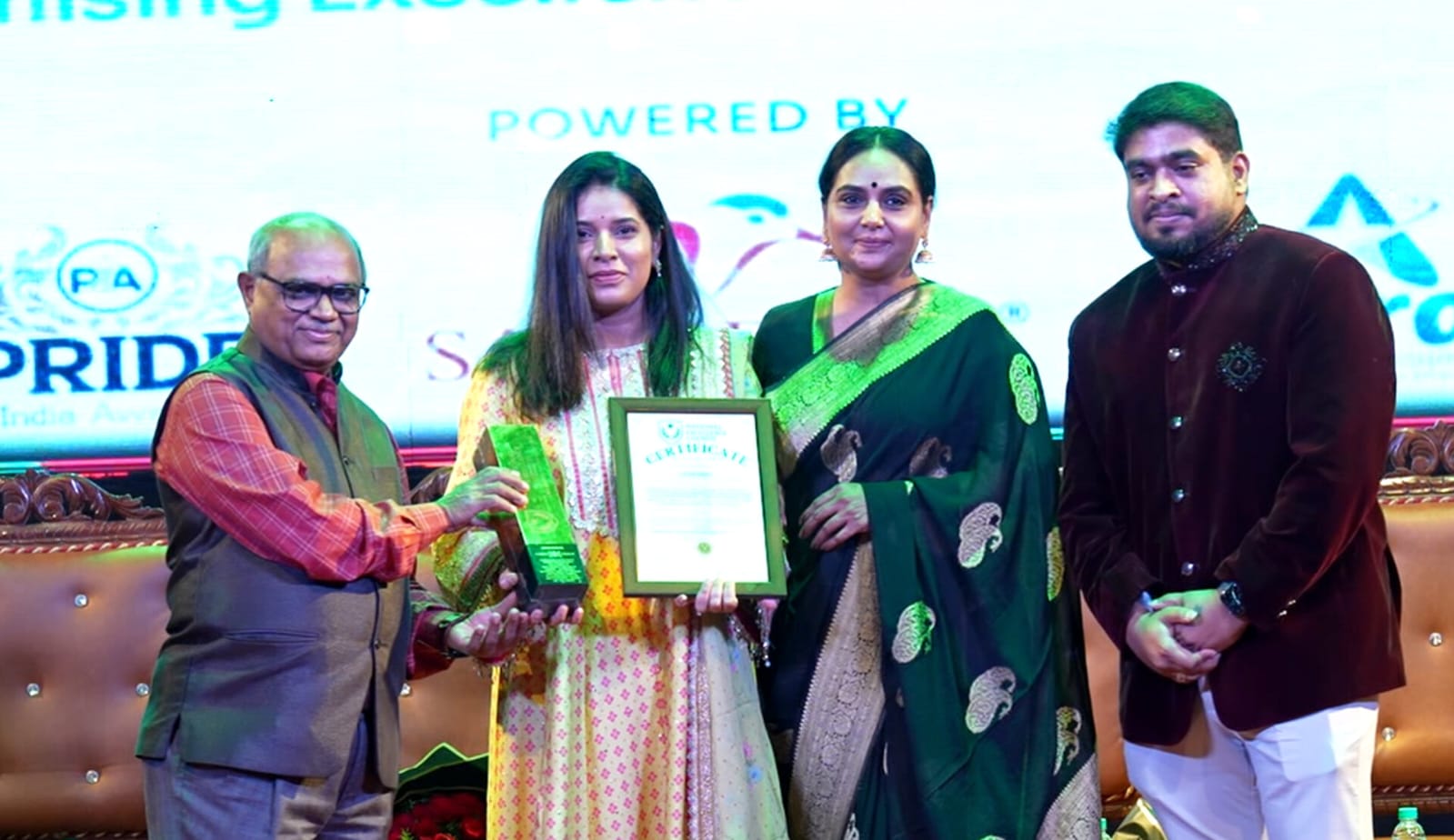
Recently, Urbanrac received the Karnataka Excellence Award for Emerging Excellence in Sustainable Children’s Fashion — recognising its commitment to organic fabrics, eco-conscious values, and purposeful design. For a brand built entirely without outside funding, it is a meaningful moment. Teja receives it quietly.
“It’s encouraging,” she says. “But we’re still a young brand figuring things out every day. What actually tells me we’re doing something right is when a parent says their baby slept through without scratching. That’s what I’m working toward.”
Where To Find Urbanrac
Urbanrac is available at www.urbanrac.in, and on FirstCry and Myntra for parents who prefer established marketplaces.
For moments that don’t run on schedule — the unexpected mess, the 9 PM realisation that there’s nothing clean for tomorrow — Urbanrac is also on Peeko (Bangalore), a quick commerce platform built specifically around the needs of parents and babies. Peeko stocks the full ecosystem of early parenting: diapers, breast pumps, feeding bottles, baby bedding, swaddles, bath towels, carry cots, mosquito repellent, and toothpaste — and now, Urbanrac’s skin-safe essentials alongside them. Parenting rarely waits for next-day delivery. Urbanrac doesn’t either.
The Bigger Thing This Points To
Urbanrac is not trying to disrupt the children’s clothing industry. It is trying to do one thing well: make essentials worthy of the 40,000 hours babies spend in them — the tens of thousands of hours of direct fabric-to-skin contact that happen quietly, every day, in every Indian home with a young child. Most brands don’t do that arithmetic. Teja Reddy does.
And she is building Urbanrac, stitch by bootstrapped stitch, entirely on her own terms — to prove that an Indian brand can meet that standard without importing the solution or outsourcing the conviction.
“Every child deserves to be comfortable,” she says. “That’s the whole thing.”
Urbanrac is available at https://urbanrac.in/, on FirstCry, Myntra, and on Peeko for quick delivery across India.
Karnataka Excellence Award — Emerging Excellence in Sustainable Children’s Fashion, 2024
